

Distinct Avenues for Creative Expression
Different styles of dot art offer remarkably distinct avenues for creative expression, each carrying its own technique, visual language, and historical context. Expanding on the foundational origins of these traditions opens a practical, technique-focused perspective—offering enough understanding of each style’s unique visual framework to draw inspiration thoughtfully, while honoring the boundaries of sacred or culturally protected work.
Aboriginal Dot Painting
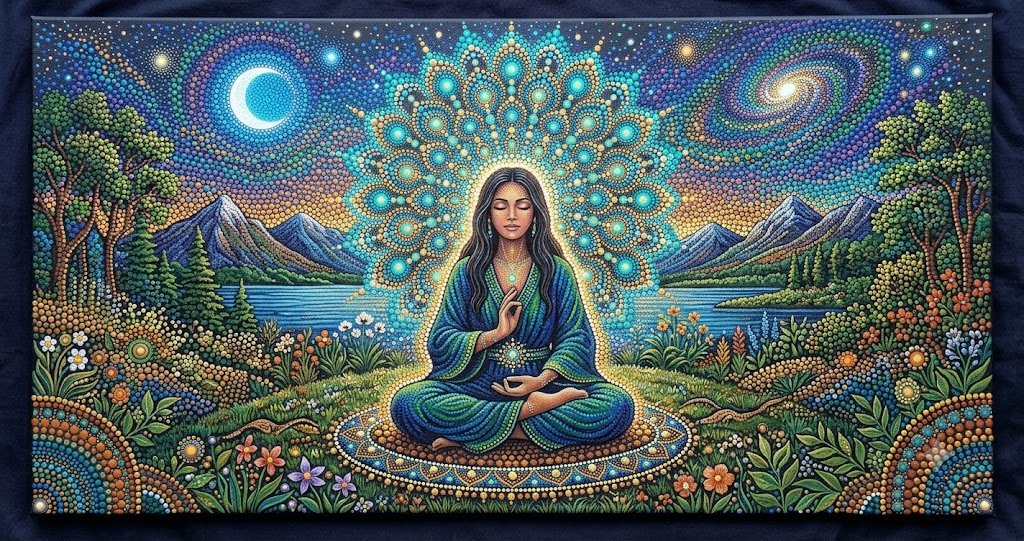
Aboriginal dot painting carries profound cultural and spiritual significance, where specific stories, symbols, and motifs belong strictly to the artists and Indigenous communities who created them. Rather than serving as a “how-to,” an appreciation of this tradition focuses on its general visual characteristics: earthy ochre palettes, sweeping radial or circular compositions, and layers of dots historically used to build texture and veil sacred imagery from the uninitiated. Approaching this art form requires respectful engagement. Readers looking to explore this heritage deeper are encouraged to seek out and support contemporary Aboriginal artists rather than attempting to replicate specific traditional symbols. There is a vital distinction between drawing inspiration from a general visual approach—such as repetitive, earth-toned dotting—and appropriating specific cultural iconography whose deeper meanings fall outside a maker’s own lived experience.
Pointillism
In contrast, Pointillism is a Western fine-art movement without cultural restrictions, making its foundational methods directly teachable. Developed in the late nineteenth century, Pointillism relies on small, distinct dots of pure, unmixed color applied methodically to construct form, light, and shadow. Its defining feature is optical color mixing, where adjacent dots of contrasting hues blend within the viewer’s eye rather than on the palette. Traditionally favored for landscapes, portraiture, and figurative scenes rather than abstract or symmetrical patterns, Pointillism offers an exceptional training ground for practice. A simplified Pointillist study—such as depicting a single piece of fruit or a simple landscape using dots of just two or three primary colors—serves as an ideal exercise in building patience, color theory, and close observation.
Mandala Dot Art
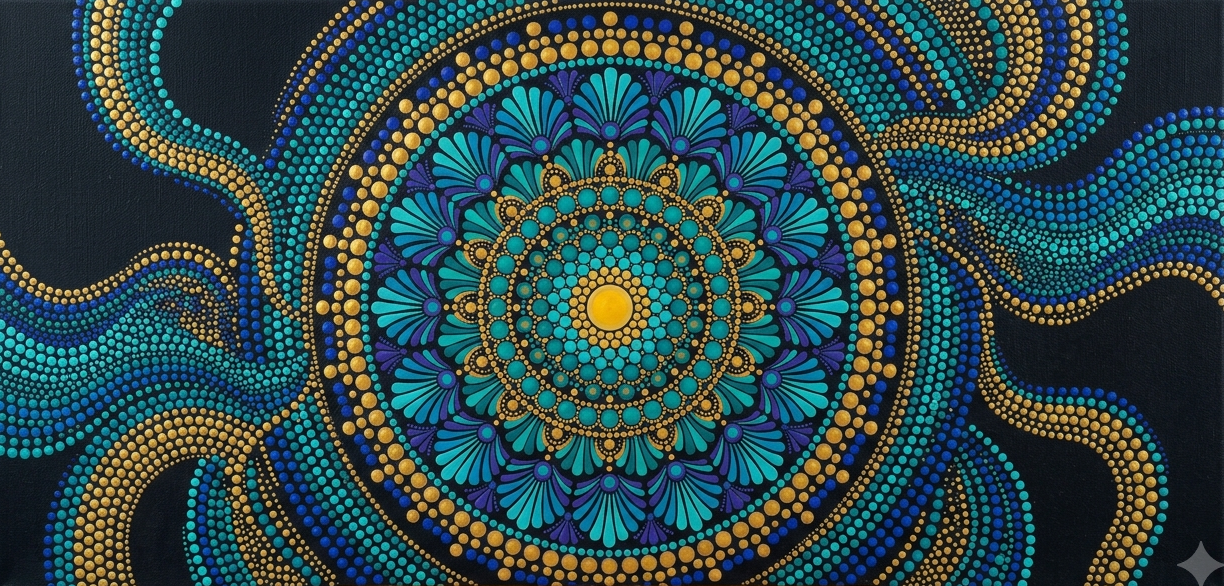
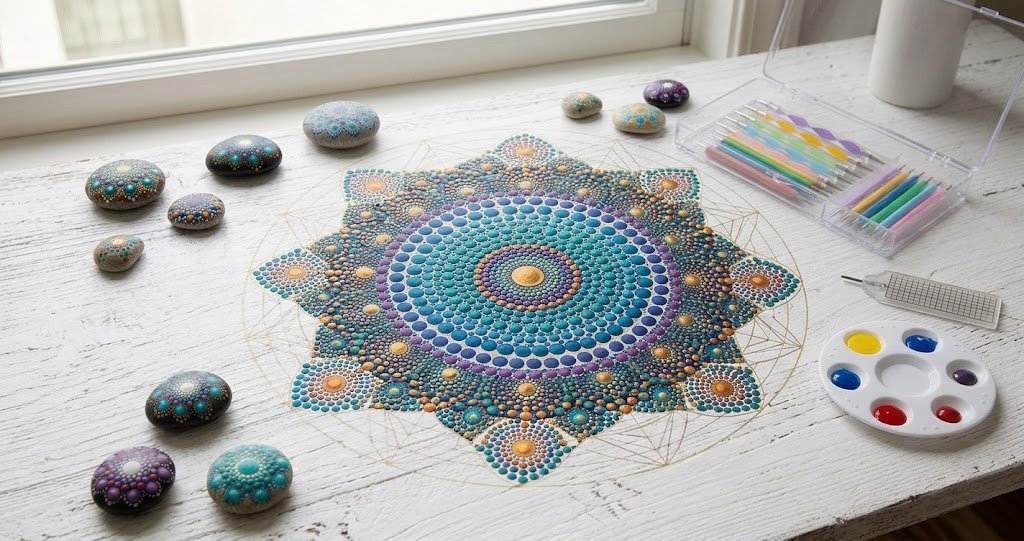
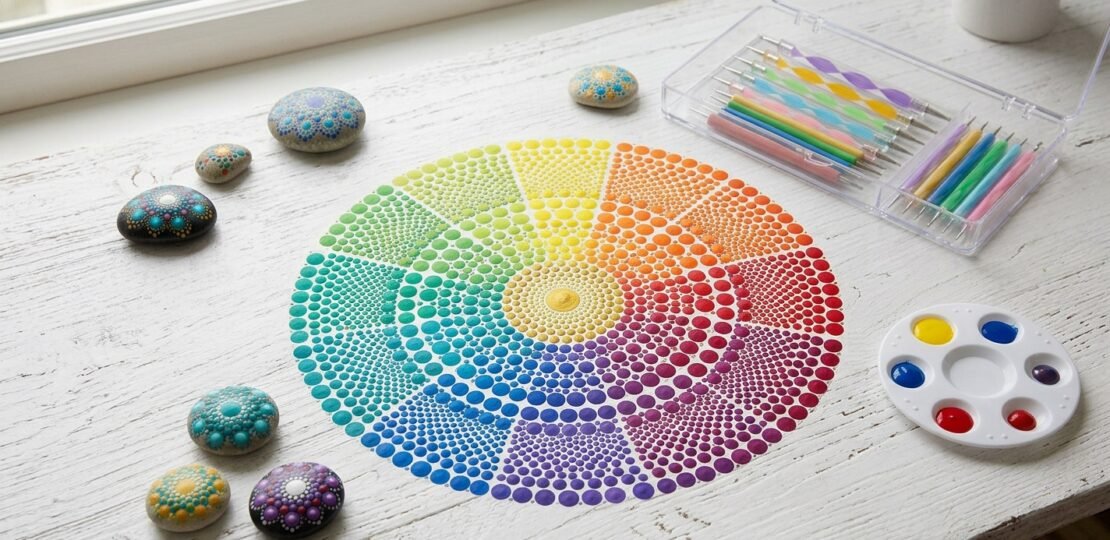
Mandala dot art has emerged as the most prevalent style within the modern mindful art movement. While visually influenced by traditional Asian and Indigenous geometry, this contemporary approach is largely a modern wellness phenomenon rather than a direct continuation of any single ancestral practice. Typically constructed from concentric rings and radial symmetry on smooth rocks, wooden panels, or canvas using fluid acrylics and specialized dotting tools, it combines diverse decorative influences with an accessible, modern sensibility. Because of the wide availability of tools, stencils, and step-by-step guides, mandala dotting stands as one of the most approachable entry points for beginners seeking a structured, meditative art form.
Rangoli
Another grid-focused approach draws inspiration from Rangoli, a traditional Indian art form where dot grids act as structural blueprints for complex geometric or floral patterns. While traditional Rangoli relies on colored powders, rice flour, or flower petals to decorate doorways and courtyards, its core design principles translate beautifully to permanent dot art on paper or canvas. The defining element here is precision: exact, evenly spaced grids provide the skeleton through which intricate dots and connecting lines flow. Crafters can readily borrow this grid-based planning method to structure their own original compositions without copying specific sacred or festivity-bound motifs.
Stippling
For those drawn to fine illustration, stippling provides a rendering method focused on light and shadow. Popularized in pen-and-ink drawing, stippling uses varying densities of uniform dots to create tonal value, texture, and three-dimensional volume, typically executed in monochromatic black ink. Unlike the repetitive geometry of mandalas, stippling demands intense focus on observational realism, spatial relationships, and form. It serves as an excellent alternative for artists who prefer representational drawing over decorative patterning, providing a quiet, highly focused meditative flow through tiny adjustments in dot proximity.
Meditative Awareness
Ultimately, no single style of dot art is inherently more mindful than another. The quality of meditative awareness comes entirely from the attention brought to the stroke itself. Selecting a direction comes down to personal temperament and creative intention. Mandala and Rangoli-inspired designs naturally suit makers who thrive on structure, geometry, and rhythmic ritual. Pointillism and stippling appeal to those who enjoy observational study and slow, detail-driven focus. Meanwhile, free-form, organic dotting offers a path for anyone wishing to cultivate spontaneity and non-attachment, letting each dot fall where it may without anxiety over the final outcome.
RELATED POSTS
View all