

All blog posts
Explore the world of design and learn how to create visually stunning artwork.
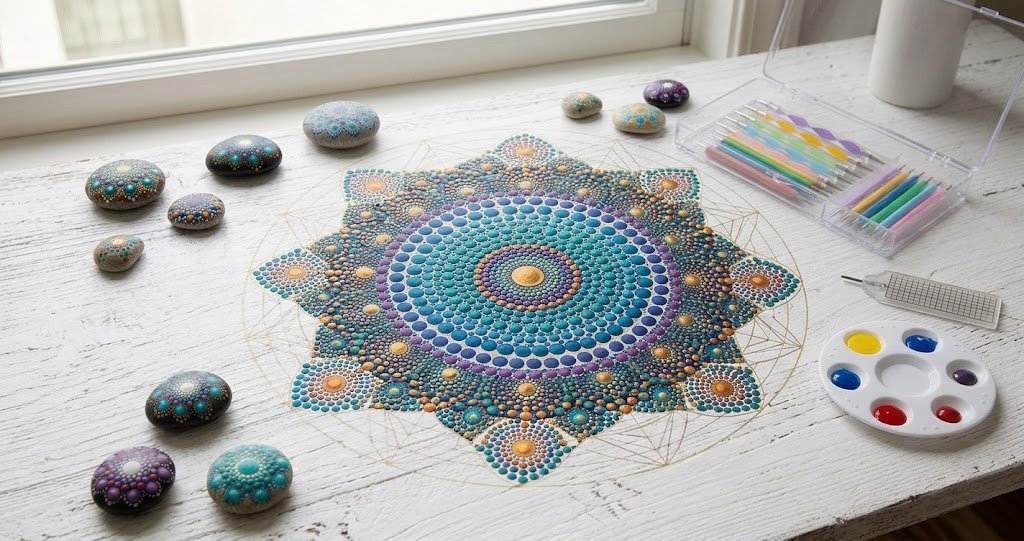



With tools, technique, and color established, the focus shifts to how individual dots unite to form structured, intentional designs. Most dot art compositions rely on an underlying grid that anchors the overall layout, even if that guide is ultimately obscured by the finished piece. Radial grids—featuring lines extending outward from a central point—serve as the foundation for classic mandalas, while rectangular grids support geometric patterns and borders. For more organic arrangements, freehand pencil guides offer simple reference points without rigid constraints. Approaching this initial layout with care transforms what is often dismissed as tedious prep work into a calm, unhurried act of present-moment attention.
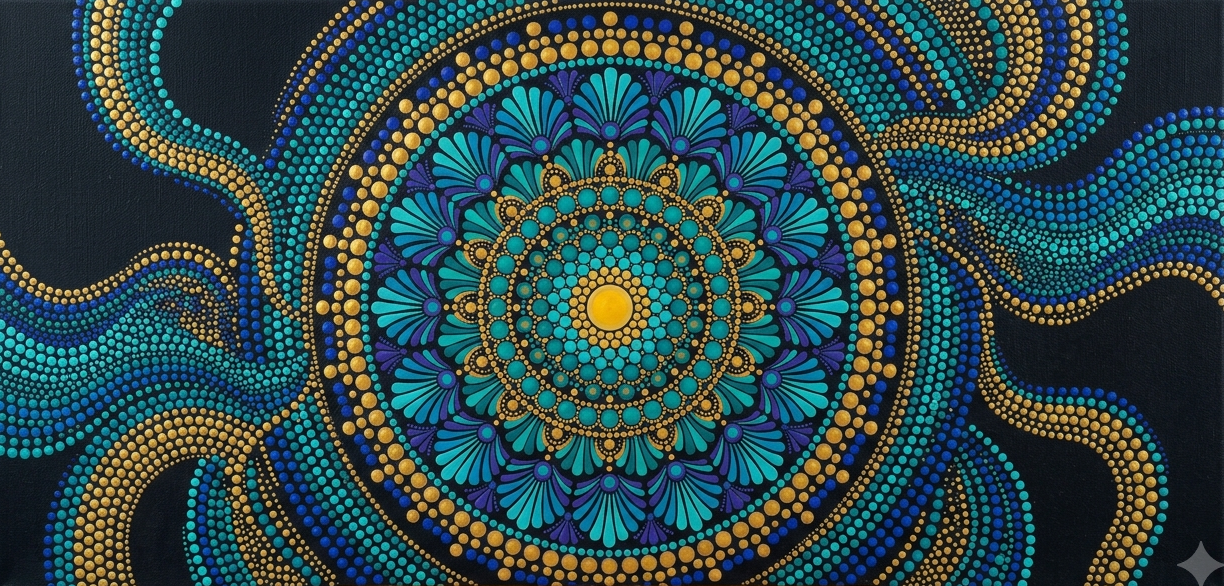
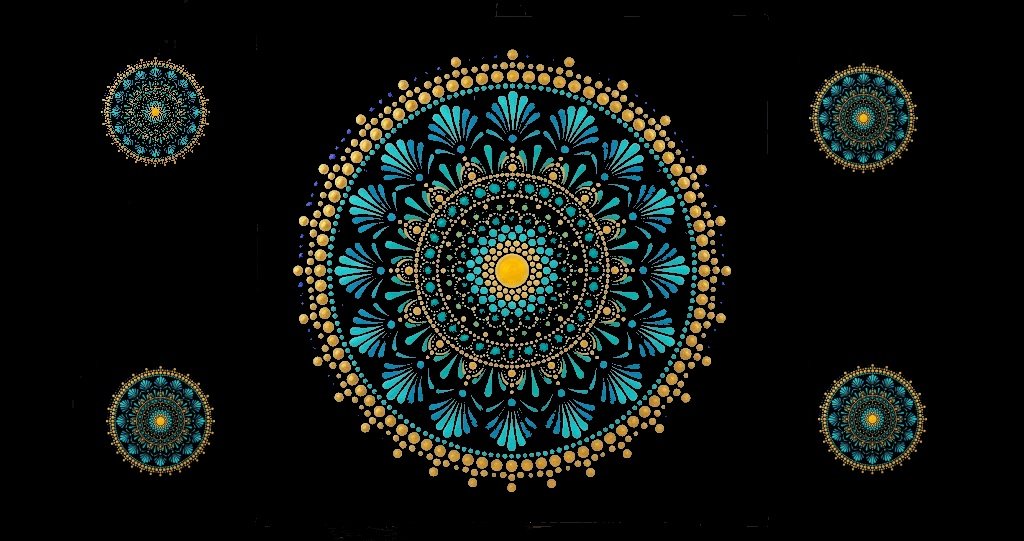
The spatial arrangement of a piece relies on core compositional structures that shape its visual flow. Concentric circles radiating from a central point remain the most fundamental mandala layout, traditionally symbolizing wholeness and containment. Radial symmetry—often built around six-, eight-, or twelve-fold axes—creates balance and visual harmony, whereas bilateral symmetry mirrors elements across a single axis for more representational designs like butterflies or faces. Linear repetition arranges dots sequentially along a line for borders and simpler projects, while free-form compositions bypass strict rules entirely to follow intuitive, asymmetrical paths.
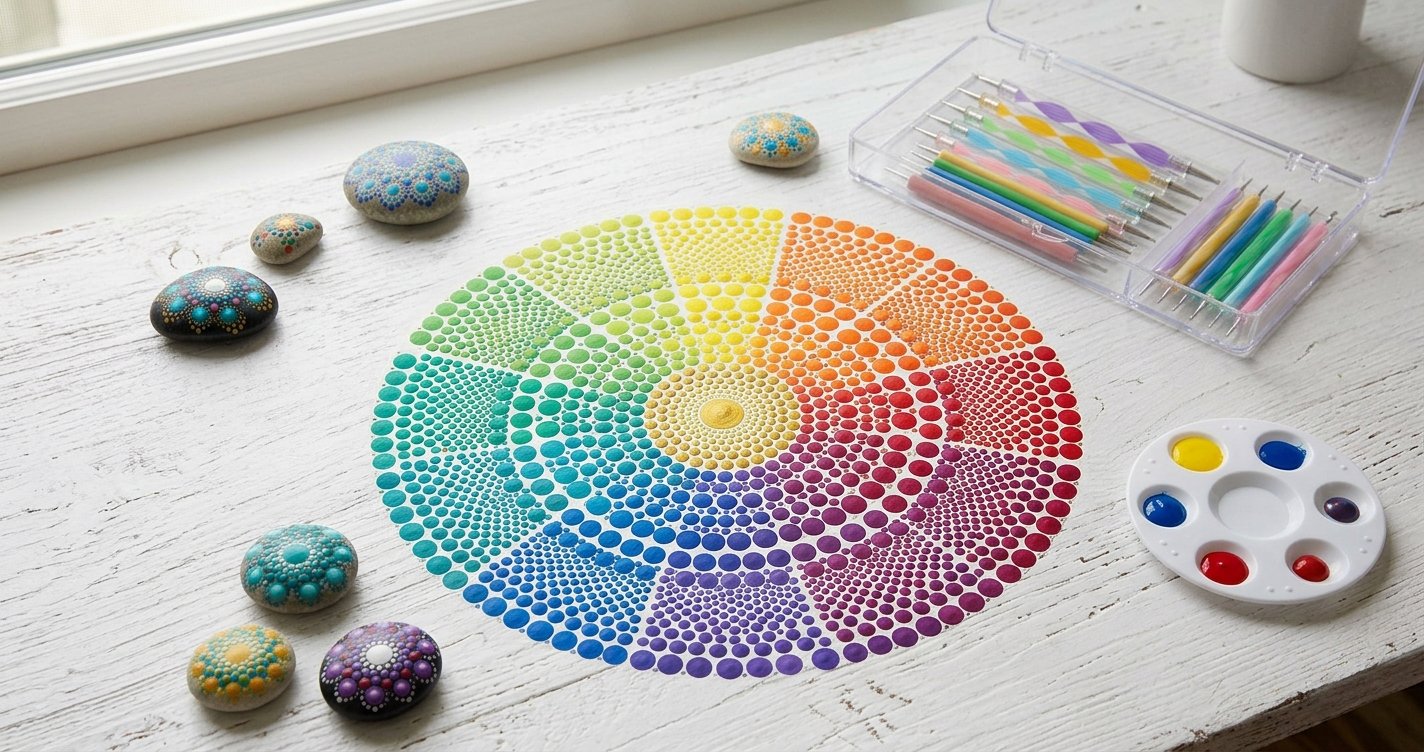
Visual balance in dot art relies heavily on density, negative space, and focal points. Varying how tightly packed dots are creates a sense of light, shadow, and movement without needing to change colors. Equally important is negative space; unmarked areas function as active design elements rather than empty voids, giving the viewer’s eye a place to rest. Most mandala-style designs draw attention inward toward a central focal point, using ring size, color intensity, and fine detail to guide the viewer’s gaze. Layering the composition in successive rings—working steadily outward or inward—allows the design to develop with a natural, built-in rhythm.
When beginning a new project, artists can choose between planned and spontaneous approaches based on their goals. A fully planned composition involves sketching the design in advance, allowing the artist to rest in the soothing, predictable repetition of execution. Conversely, a spontaneous composition lets the pattern emerge dot by dot, turning every structural choice into an active exercise in present-moment responsiveness. Regardless of the chosen path, hand-crafted symmetry is rarely mathematically perfect. Embracing slight variations as part of the medium’s organic character reinforces non-judgmental acceptance, reframing minor imperfections as natural markers of the human hand.